Alongside his coaching practice for more than a decade, he runs his research portal Know Your True Self Research Academy (KYTS).
He is among the pioneer promoters of Emotional Health and well-being in INDIA and other countries since 2005 and apart from 10000 hours of personal coaching experiences, he runs workshops and seminars under his own initiative MEHAC - Mental & Emotional Health Awareness Campaign to not only spread awareness but also to equip the individuals to take charge of their own emotional health and well-being.
- The Quiet Cost of Self-Deception - December 31, 2025
- When the World Arrives Quietly - December 31, 2025
- Embracing Intellectual Honesty in the Age of AI & Machine Learning - November 9, 2024
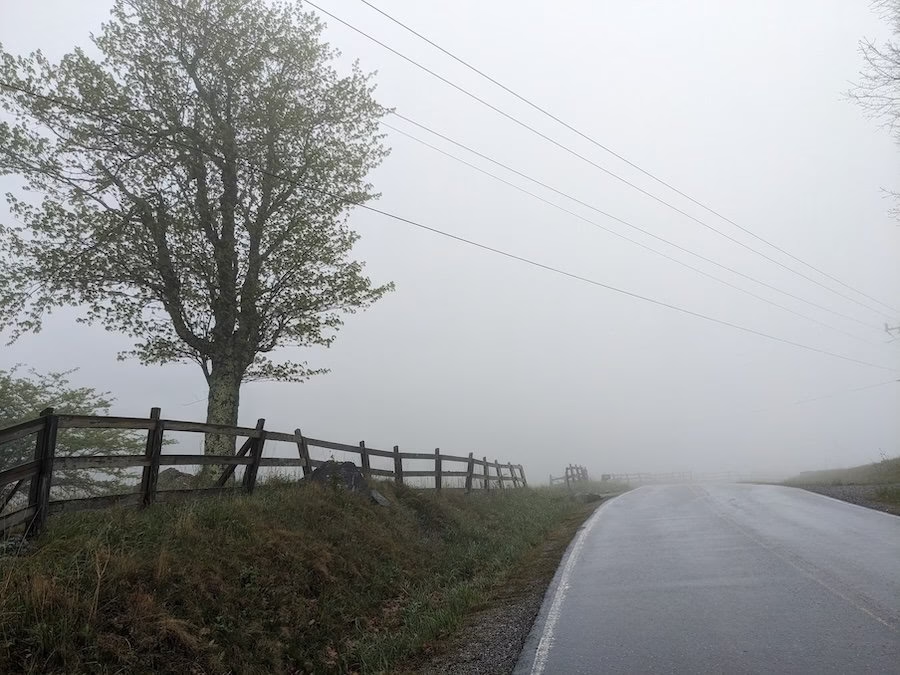

Some people meet the world as information.
Others meet it as an experience.
And then there are those for whom the world arrives quietly — but deeply.
Not all at once, not dramatically, not loudly.
It arrives in layers. In tone. In undercurrents. In what is said, and in what is carefully left unsaid.
This is often what we call sensitivity.
Not as a label or a personality type — but as a way perception organises itself.
For a sensitive mind, awareness doesn’t move in straight lines.
It widens. It listens. It notices before it concludes.
You may sense the atmosphere of a room before the conversation begins.
You may feel the emotional weight behind a decision long before the logic is articulated.
You may register the pause between words more clearly than the words themselves.
This isn’t effort.
It isn’t overthinking.
It’s simply how awareness lands.
Sensitivity, at its core, is not about feeling more.
It is about receiving additional layers of reality simultaneously.
A different relationship with perception
A sensitive mind doesn’t skim life — it absorbs it.
Information doesn’t stay neutral for long.
It becomes meaning.
Meaning becomes responsibility.
This is why sensitive individuals often struggle to separate observation from implication.
What they see does not remain abstract. It enters them.
A raised eyebrow isn’t just a gesture.
A change in tone isn’t just sound.
A casual remark isn’t always casual.
The world feels alive — responsive, relational, consequential.
And because of this, perception naturally shapes ethics.
When you sense impact early, you become careful.
When you feel consequences inwardly, you hesitate before acting.
When you notice nuance, you resist bluntness — not out of fear, but out of awareness.
Sensitivity doesn’t make someone moral by default.
But it does make it harder to act without noticing.
Why sensitivity often feels like “too much”
For many sensitive people, the problem is not depth —
it is volume without context.
When no one helps you understand why you notice so much,
what you feel begins to feel excessive.
You are told you are overreacting.
Too emotional.
Too intense.
Too slow.
Too affected.
So you begin to doubt your reception of reality.
You try to lower the volume —
not realising the issue was never the volume itself,
but the lack of guidance on how to relate to it.
Sensitivity becomes overwhelming when it is unnamed, unsupported, or misunderstood.
Without language, depth feels like burden.
Without permission, care feels like weakness.
Without grounding, awareness feels like exposure.
When awareness is missing, confidence quietly erodes
Sensitivity becomes overwhelming not because it is excessive,
but because it is often unconscious.
When you do not understand how your inner system works,
every strong perception feels like a loss of control.
You begin to mistrust your responses.
You second-guess your instincts.
Slowly, confidence erodes — not through failure, but through self-doubt.
What could have been clarity becomes confusion.
What could have been discernment becomes hesitation.
What could have been inner strength begins to feel like emotional liability.
Sensitivity without awareness does not build confidence —
it quietly drains it.
Sensitivity and decision-making
One of the quieter costs of sensitivity is decision fatigue.
Because you don’t only ask,
“What is efficient?”
You also ask,
“What is honest?”
“What will this affect?”
“What will this cost — inwardly?”
Sensitive decision-making is slower not because it is confused,
but because it is relational.
It considers people.
Timing.
Energy.
Integrity.
This is why sensitive individuals often appear hesitant in a world that rewards speed.
But hesitation is not always weakness.
Sometimes it is discernment refusing to be rushed.
The quiet shift
I used to think I felt too much.
Now I see I was simply receiving the world at its full volume.
The shift did not come from toughening up —
but from understanding what my sensitivity was actually doing.
It wasn’t trying to protect me.
It wasn’t trying to sabotage me.
It was trying to inform me.
When sensitivity is no longer treated as a flaw to fix,
something subtle changes.
You stop apologising for your depth.
You stop abandoning your perceptions.
You stop outsourcing your inner authority.
Sensitivity begins to feel less like exposure
and more like orientation.
Not something you defend.
Something you learn to stand within.
A closing reflection
Sensitivity is not a weakness to overcome.
It is a capacity to relate — to life, to people, to consequence.
When understood, it refines perception.
When grounded, it clarifies ethics.
When trusted, it steadies decision-making.
The world does not need fewer sensitive minds.
It needs more people who know how to live with their sensitivity —
without shame, without performance, without withdrawal.
Some minds are not meant to rush the world.
They are meant to meet it carefully.
Quietly.
A final note
This understanding is also what led me to write Mastering Sensitivity.
Not as a guide to becoming less sensitive —
but as an invitation to become conscious of one’s sensitivity.
When sensitivity is met with awareness, it stops feeling like something to fix or overcome.
It becomes a strength to be held responsibly —
a capacity that can be refined, grounded, and trusted.
For many sensitive individuals, the work is not about changing who they are,
but about learning how to stand steadily within it.
